


Countertop blenders are the highest-selling category in small kitchen appliances globally. Retail demand is rising across Asia, the Middle East, Africa, and Europe. And yet, more wholesale orders fail at the product selection stage than at any other point in the process.
The reason is simple. Most importers choose a blender based on wattage and price. Both are visible on a spec sheet. Neither one tells you whether the product will perform reliably in your market, pass import inspection, or satisfy retail customers after six months of use.
What actually determines a successful wholesale order is a combination of four things:
- The right product type matched to your target retail channel
- Motor specs that reflect real-world performance — not just peak wattage
- Certification coverage that meets your import market requirements
- A supplier whose production quality holds up across batches — not just samples
This guide is designed for importers, wholesale distributors, and retail brand buyers evaluating countertop blenders for bulk ordering. It covers product types, performance specs, sourcing models, and certification requirements — giving buyers the practical knowledge to select the right product for their market and place volume orders without risk.
Key Highlights
- Global countertop blender market growing at 6–8% annually
- Countertop blenders are a stable, high-demand wholesale category globally
- Four product types → personal-size, mid-range, high-power, programmable
- Motor power, duty cycle, and certifications → most critical evaluation factors
- Mid-range 1000W–1500W segment = highest wholesale demand globally
- CE + RoHS required for EU / UL or ETL required for US market entry
- OEM is the most practical starting model for first-time importers
- Sample testing before bulk orders reduces return rate by up to 60%
Quick Answer
A countertop blender wholesale order succeeds when the product type, motor specifications, certifications, and supplier capability are all matched correctly to your target market and retail channel.
What Is a Countertop Blender — From a Wholesale Perspective
A countertop blender is a motorized kitchen appliance that sits on a flat surface and processes ingredients using high-speed rotating blades inside a jar. For wholesale buyers, it is one of the most consistently high-demand products in the small kitchen appliance segment.
Unlike single-use appliances, countertop blenders serve multiple consumer needs — smoothies, soups, sauces, baby food, and frozen drinks — which means they appeal to a broad retail base and sell across multiple channels simultaneously.
What makes this category different from other wholesale products is the gap between how a blender looks on paper and how it performs in real use. Two blenders with identical wattage ratings can deliver completely different results depending on motor grade, blade design, duty cycle, and jar material.
This is why product selection — not just pricing — determines whether a wholesale order generates repeat business or retail returns.
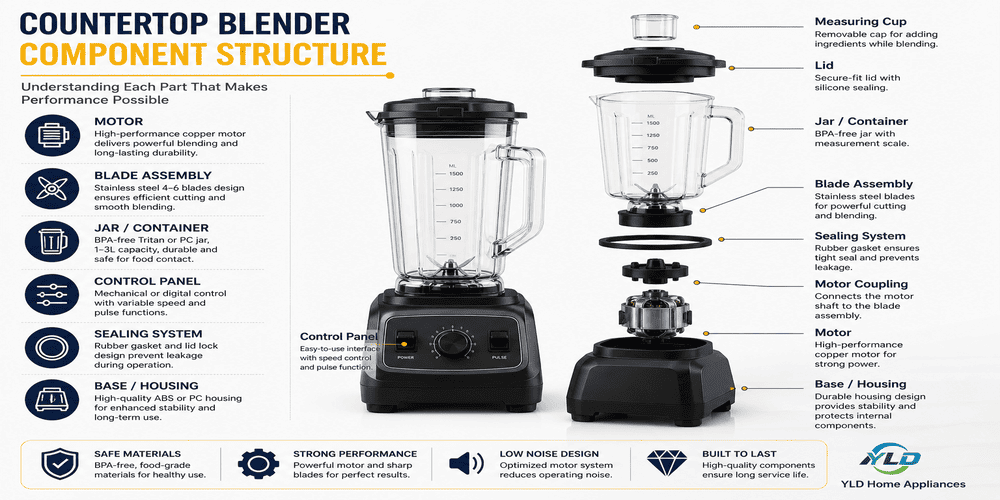
A complete countertop blender system consists of several components that directly affect performance:
| Component | Typical Specification | Function |
| Motor | 600W – 2000W | Drives blade speed and performance |
| Blade Assembly | Stainless steel, 4–6 blades | Cuts and processes ingredients |
| Jar / Container | BPA-free Tritan or PC, 1–3L | Holds ingredients safely |
| Base / Housing | ABS or PC body | Structural durability |
| Control Panel | Mechanical or digital | Speed and program control |
| Sealing System | Rubber gasket + lid lock | Prevents leakage during operation |
Each component directly affects the final product experience. For example, a high-wattage motor paired with low-grade blades will still underperform. And a well-made jar with a weak sealing system creates leakage complaints at the retail level.
For a detailed overview of YLD Group’s countertop blender product range, see Countertop Blenders — YLD Group Product Category
For information on OEM and ODM services, visit YLD Group OEM/ODM Solutions
Why Countertop Blender Demand Keeps Growing
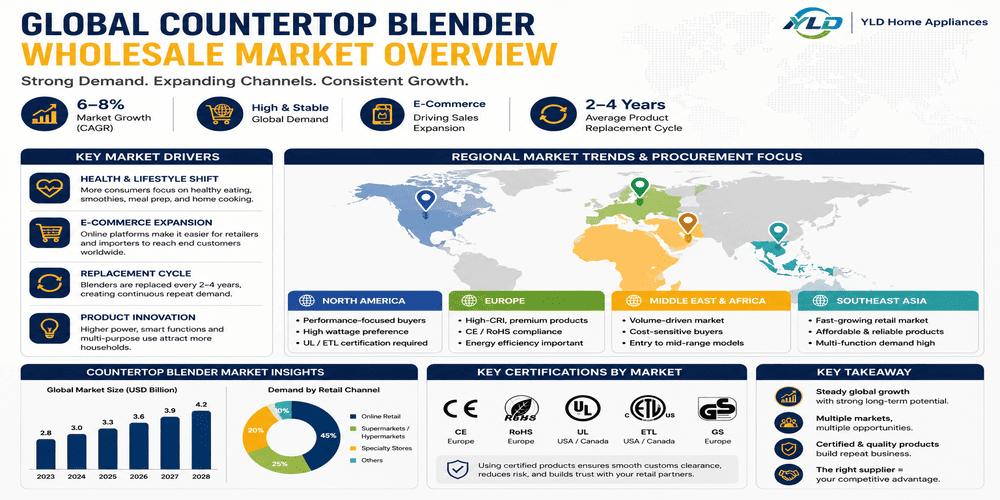
Countertop blender demand is not a trend. It is a stable, multi-year growth category driven by overlapping forces that make it one of the safest wholesale bets in small kitchen appliances.
Three forces are driving consistent global demand:
The first is the health and lifestyle shift. Consumers across all income levels are investing in home food preparation. Smoothies, meal prep, soups, and sauces have moved from niche behavior into daily household habits — and this behavior is now spreading across emerging markets in Asia, the Middle East, and Africa.
The second is e-commerce channel expansion. Online retail has made it significantly easier for importers to reach end consumers directly, improving per-unit margins and increasing inventory turnover speed.
The third is the natural replacement cycle. A household blender purchased today will typically be replaced within two to four years. This means every unit sold generates future demand — and every distributor who builds early supply chain relationships benefits from that ongoing cycle.
Real-World Market Data:
| Region | Market Trend | Procurement Focus |
| Europe | High-CRI, certified products | CE/RoHS compliance, premium builds |
| North America | Performance-focused buyers | UL/ETL certified, mid-to-high wattage |
| Middle East & Africa | Volume-driven, cost-sensitive | Entry to mid-range models |
| Southeast Asia | Fast-growing retail market | Affordable, multi-function products |
What this means in practice: If you are placing your first wholesale order in this category, you are not entering a saturated market. You are entering a growing one — with room for new entrants who source the right product at the right quality level.
Decision Rule:
- Emerging market → entry-level to mid-range models, competitive price point
- Developed market → mid-range to premium, strong certification coverage
- First-time importer → start with stock or OEM, test before scaling
For YLD Group’s global wholesale capabilities, see YLD Group — Wholesale Kitchen Appliances from China
Countertop Blender Models: Which One Aligns With Your Target Market?
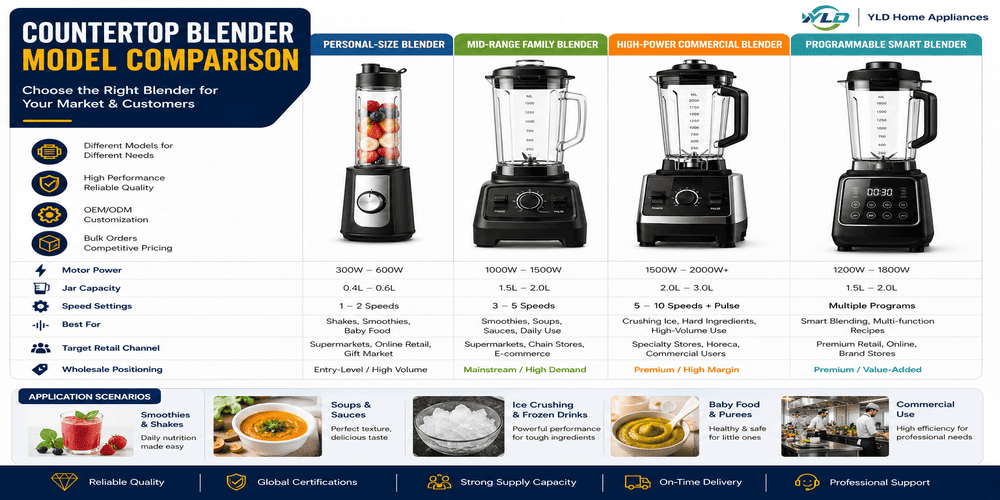
Not every countertop blender serves the same buyer. Before placing a bulk order, the first decision is matching the product type to your retail channel and target consumer.
In real-world wholesale buying, mismatching the product type to the retail channel is the most common reason orders underperform — not price, and not motor wattage.
| Type | Motor Power | Jar Capacity | Best Retail Channel | Typical Market |
| Personal-Size | 600W – 900W | 1 – 1.5L | Supermarket, Online | Entry-level retail |
| Mid-Range Family | 1000W – 1500W | 1.5 – 2L | Multi-format Retail | Widest consumer base |
| High-Power Commercial | 1500W – 2000W | 2 – 2.5L | Specialty, HoReCa | Food service buyers |
| Programmable Smart | 1500W – 2500W | 1.5 – 3L | Premium Retail | Tech-oriented consumers |
Personal-Size Countertop Blender (600W–900W)
Targets single-person households and entry-level retail price points. Moves quickly through supermarkets, discount chains, and online marketplaces. The lower price point makes it easy to generate volume quickly.
Best for: First-time importers testing a new market, or distributors looking to add an accessible SKU to their product line.
Mid-Range Family Blender (1000W–1500W)
This is the highest-volume wholesale segment globally. It covers the widest consumer base and fits across multiple retail formats — from modern trade to e-commerce. Margins are balanced and consumer satisfaction rates are consistently high when the product is sourced from a reliable manufacturer.
Best for: Any importer building a primary product line for household retail distribution.
High-Power Commercial Blender (1500W–2000W)
Serves small food businesses, juice bars, and performance-focused consumers. Commands a higher retail price and requires stronger certification coverage for commercial environments. Buyer expectations around product consistency are significantly higher.
Best for: Distributors serving HoReCa or specialty retail channels.
Programmable Smart Blender (1500W–2500W)
The premium segment. These blenders include preset speed programs, touch panel controls, and auto-clean functions. They target tech-oriented consumers and premium retail environments. Higher wholesale margins but also higher risk if product quality is inconsistent.
Best for: Established importers with existing premium retail relationships.
Key Insight: Most wholesale failures in this category come from mismatching the product type to the retail channel — not from choosing the wrong motor wattage.
For YLD Group’s full countertop blender range including product specs, see Countertop Blender Product Category
For portable and handheld blender options as complementary SKUs, see Hand Blenders and Portable Blenders
Key Performance Factors — What Wholesale Buyers Must Evaluate
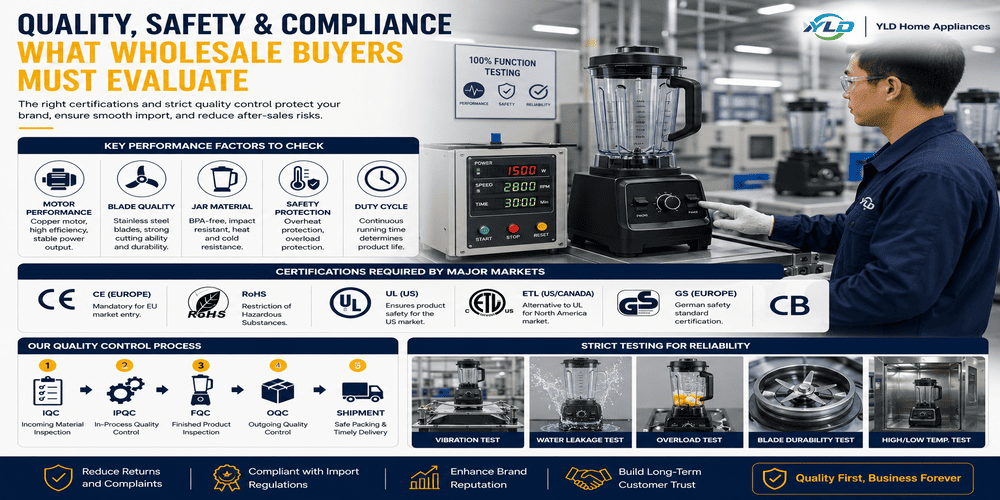
Choosing a blender based on wattage alone is the most common and most expensive mistake importers make. In real-world retail, what determines whether a consumer keeps or returns a product is a combination of factors that go beyond the spec sheet.
A blender that looks strong on paper can still fail in the field — if the right factors are not evaluated before ordering.
Motor Duty Cycle — The Spec Most Importers Ignore
The duty cycle tells you how long the motor can run continuously before it needs to rest. A 50% duty cycle means the motor runs 30 seconds and rests 30 seconds.
- For household retail → 50% duty cycle is usually acceptable
- For any food service or commercial environment → you need a higher duty cycle rating
What this means: A blender with a 50% duty cycle marketed to food businesses will generate returns and negative reviews — regardless of how high the wattage rating is.
Blade Material and Assembly — Where Performance Is Made or Broken
Stainless steel is the standard for quality wholesale products. The key factors to evaluate are:
- Number of blade tips (more = finer blending)
- Blade thickness and reinforcement
- Blade-to-jar fit (loose blades cause leakage and vibration)
For hard ingredients like ice, frozen fruit, and nuts → reinforced blade assemblies with 6 tips are the minimum standard.
Container Material — A Compliance and Marketing Factor
| Material | Standard | Best For |
| BPA-free Tritan | Food safety | Premium retail, EU/US markets |
| Food-grade PC | Cost-effective | Mid-range retail |
| Stainless Steel | Commercial grade | HoReCa environments |
BPA-free containers are both a selling point in health-conscious retail markets and a compliance requirement in several regulated markets.
Certifications — Non-Negotiable for Market Entry
A product without the correct certification for your target market cannot legally be sold — regardless of how competitive the unit price is.
| Certification | Required For | What It Covers |
| CE + RoHS | EU / European markets | Safety + environment |
| UL / ETL | US market | Electrical safety |
| CB | Multi-market entry | International standard |
| ISO 9001 | Manufacturing quality | Production consistency |
Real Insight: In real-world wholesale use, the certification gap is the single most common reason a shipment gets held at customs or rejected by a retail buyer. Always confirm certification status before finalizing any product selection.
What this means: A well-specified blender at a slightly higher unit cost will always outperform a cheaply-specced blender at a lower price — because the cost of returns, replacements, and lost retailer trust far exceeds the per-unit savings.
For YLD Group certification details including CE, RoHS, CB, GS, UL, and ETL coverage, see YLD Group Appliance Certifications
For sample testing before bulk orders, see YLD Group Sample Test Service
OEM vs ODM vs Stock — Which Sourcing Model Fits Your Business?
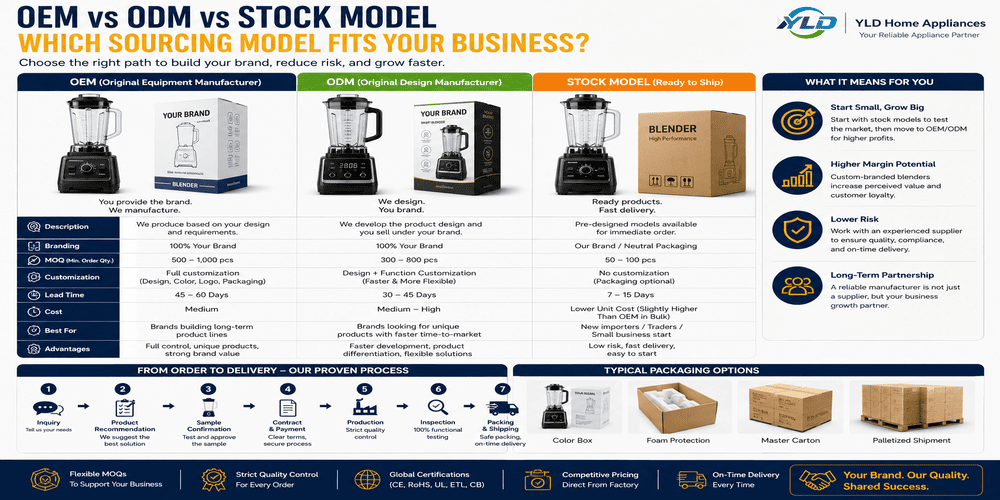
Before placing a bulk order, the most important business decision you will make is choosing the right sourcing model. This decision affects your upfront investment, your product ownership, your lead time, and your long-term brand strategy.
Unlike material or spec decisions, the sourcing model is a structural choice — and changing it later is expensive.
There are three sourcing paths available to wholesale buyers:
| Sourcing Model | What It Means | MOQ Range | Lead Time | Best For |
| Stock Models | Ready-made product, no customization | 50–200 units | 3–7 days | First-time buyers, fast market entry |
| OEM | Manufacturer’s design + your branding | 100–500 units | 15–30 days | Brand building with lower investment |
| ODM | Your specs + manufacturer’s production | 300–1000 units | 30–60 days | Full product differentiation |
Stock Models — Fastest Path to Market
Stock models are ready-made products available for immediate shipment. There is no customization involved. You receive the manufacturer’s standard product, apply your own packaging if needed, and move inventory quickly.
This model works best for:
- Distributors testing a new market
- Buyers with tight lead time requirements
- Importers who want to sell quickly before committing to larger volumes
Real Insight: Stock models carry the lowest risk but the lowest margin protection. Any competitor can source the same product from the same factory.
OEM (Original Equipment Manufacturer) — The Most Practical Starting Point
OEM means you take the manufacturer’s existing product design and apply your own branding — logo, color, packaging. The core product remains the manufacturer’s design, but it enters your market under your brand identity.
What you control in OEM:
- Brand logo on product and packaging
- Color options within available configurations
- Retail packaging design and language
- Instruction manual and accessory content
This model works best for: Importers building their own brand with lower development investment. It reduces risk while allowing you to establish brand presence in your market.
ODM (Original Design Manufacturer) — Full Product Ownership
ODM means the manufacturer builds a product based on your specifications. You control the design, features, and performance requirements. The factory executes production.
What you control in ODM:
- Motor wattage and duty cycle
- Blade configuration and jar material
- Product dimensions and control panel layout
- All certifications applied to your brand
- All intellectual property on the design
This model requires: Higher upfront investment, longer development timeline, and clear specification documentation.
Engineering Insight: For most first-time importers, OEM is the practical starting point. It reduces risk while allowing you to build brand presence. As your volume grows, moving toward ODM gives you a competitive edge that stock and OEM buyers cannot easily replicate.
Decision Rule:
- Testing a new market → Stock
- Building a brand with lower investment → OEM
- Differentiating your product line → ODM
- Scaling an established product → ODM with exclusive agreements
For YLD Group’s OEM and ODM capabilities including in-house R&D and private label services, see YLD Group Wholesale Blenders and OEM Solutions
For prototype design and custom development support, visit YLD Group Prototyping Design Service
Wholesale Pricing Structure — What Actually Affects Your Unit Cost
Pricing in wholesale kitchen appliances is never a fixed number. The unit cost you receive is the result of several variables working together. Understanding these variables is the difference between building healthy margins and getting squeezed at every order.
The most common mistake importers make is negotiating price before locking in specs. When you negotiate price first, you are not buying the same product at a lower cost — you are buying a different product at a lower cost.
What Drives Unit Cost in Practice
| Cost Factor | Typical Impact | What It Means in Practice |
| Order Volume | 20–35% cost reduction | 500 units vs 50 units = major price difference |
| Motor Grade | 15–25% variance | Higher wattage + duty cycle = higher component cost |
| Jar Material | 10–20% variance | BPA-free Tritan costs more than standard PC |
| Blade Assembly | 8–15% variance | Reinforced 6-blade more than standard 4-blade |
| Certification | One-time cost per model | CE, UL adds to development cost |
| Packaging Type | 5–15% variance | Retail-ready vs plain brown box |
| OEM vs Stock | 10–20% OEM premium | Customization adds cost but adds brand protection |
Volume Tiers — The Biggest Lever You Have
Order volume is the single most powerful variable in wholesale pricing. The difference between a 50-unit order and a 500-unit order can result in a 20 to 35 percent reduction in unit cost — because manufacturers price aggressively for volume as it reduces their per-unit overhead.
Typical Volume Pricing Structure:
| Order Quantity | Typical Cost Position | Notes |
| 50–100 units | Base price (highest per unit) | Sample / test order level |
| 100–300 units | 10–15% below base | Small distributor level |
| 300–500 units | 15–25% below base | Mid-range importer level |
| 500+ units | 25–35% below base | High-volume wholesale level |
What You Are Actually Paying For
Lower-cost blenders may look similar on a spec sheet, but they often use weaker motors and lower-grade materials. In real-world retail, this results in:
- Higher return rates from end consumers
- Shorter product lifespan and negative reviews
- Retailer relationship damage after the first selling cycle
Real Insight: You are not just paying for a blender. You are paying for the consistency of the product across 500 units — not just the one sample you approved.
Higher-quality commercial blenders:
- Maintain stable performance under repeated daily use
- Deliver consistent output across production batches
- Last longer even with heavy usage
Key Insight: The right approach is to align your volume commitment with your target retail price point, then work backward with your supplier to identify which specifications can be adjusted to hit your margin requirements without compromising product quality.
For YLD Group’s pricing structure and wholesale inquiry process, see YLD Group — Request Instant Quote
Why Serious Wholesale Buyers Source Countertop Blenders From YLD Group
Price is easy to find. A supplier who delivers consistent quality across every batch, holds the certifications your market requires, and supports your business as it scales — that is harder to find.
YLD Group has been manufacturing small kitchen appliances from its Shenzhen facility for over 13 years. The factory covers 15,000 square meters with full in-house production capability — from mold tooling and injection through electronics assembly, quality control, and OEM packaging.
What this means for wholesale buyers: Every stage of production happens under one roof. No outsourced components. No third-party quality gaps. No coordination delays between suppliers.
Core Factory Capabilities:
| Capability | Detail |
| Factory Scale | 15,000 m² — full production, single location |
| Production Capacity | 62 machines, 300 staff |
| QC Pass Rate | 99.5% across production batches |
| R&D Team | 15 in-house technicians |
| Certifications | CE, GS, CB, RoHS, UL, ETL |
| OEM / ODM | Full in-house capability |
Certifications That Cover Your Target Market
CE, RoHS, CB, GS, UL, and ETL certifications mean YLD Group products are ready for European, US, and multi-region markets — without additional compliance investment from the buyer.
OEM and ODM Under One Roof
In-house R&D, design, tooling, and production in one facility means faster turnaround, fewer coordination points, and tighter quality control across every production run.
99.5% QC Pass Rate
Defective units cost more than their unit value. A 99.5% QC pass rate means a clean shipment — not a problem to manage after delivery.
Real Insight: The practical test is not whether the sample passes. It is whether the full batch matches the sample — and whether the next order matches the first.
For certifications, see YLD Group Appliance Certifications
For factory details, visit About YLD Group
For client network, see Our Clients
Countertop Blender Wholesale Knowledge Hub
This guide is part of a structured wholesale sourcing knowledge system designed to help importers, distributors, and B2B buyers understand countertop blender sourcing from product selection to supplier qualification.
To explore each area in more depth, refer to the following resources from YLD Group:
- Browse the full countertop blender product range Countertop Blenders — YLD Group Product Category
- Explore OEM and wholesale blender supply solutions YLD Group Wholesale Blenders and B2B Solutions
- Request a custom product prototype or design YLD Group Prototyping Design Service
- Arrange sample testing before bulk order commitment YLD Group Sample Test Service
- Apply for dealer or distributor partnership YLD Group — Become a Dealer
- Verify product certifications for your target market YLD Group Appliance Certifications
- View factory capabilities and production details YLD Group — About Us
- Request a wholesale price quote YLD Group — Instant Quote
Quick Summary
- Personal-size 600W–900W → Best for entry-level retail and supermarket channels
- Mid-range 1000W–1500W → Highest-volume wholesale segment globally
- High-power 1500W–2000W → Food service and premium retail environments
- CE + RoHS → Required for EU market entry
- UL or ETL → Required for US market entry
Countertop blenders are a stable, high-demand wholesale category with consistent global growth. The product succeeds when the right type is matched to the right market, the right certifications are confirmed before ordering, and the supplier’s production quality holds up across batches — not just samples.
Conclusion
Countertop blender wholesale success is determined by three factors: product type matched to retail channel, certifications confirmed before ordering, and supplier quality that holds across every production batch.
For importers placing volume orders, these decisions made before shipment determine the outcome — not price negotiation after.
In real-world wholesale buying, the importers who build long-term profitability in this category are not the ones who found the cheapest unit price. They are the ones who found the right product, at the right quality level, from a supplier they could rely on — and then scaled from there.
If you are looking for countertop blenders for wholesale, contact us now!
Frequently Asked Questions
Does a higher wattage blender always perform better?
Not necessarily. Performance depends on motor quality, blade design, and duty cycle — not wattage alone. A well-engineered 1200W blender consistently outperforms a poorly built 1500W model in real-world retail use.
What is the ideal wattage range for countertop blenders in wholesale?
For household retail distribution, 1000W to 1500W is the most practical range. For commercial and food service environments, 1500W to 2000W with a high duty cycle rating is the minimum requirement.
What jar material is best for countertop blenders in bulk orders?
BPA-free Tritan plastic is the preferred choice, durable, food-safe, lightweight, and cost-effective for bulk shipping. Glass jars suit premium retail segments but add weight and fragility risk during distribution.
How important is motor type in countertop blender selection?
Critical. Full copper motors deliver better efficiency, heat resistance, and long-term durability compared to aluminum motors. For wholesale buyers, motor type directly affects the return rate and lifespan complaints you manage at the retail level.
What blade type is best for commercial countertop blenders?
Stainless steel multi-angle blades with 4 to 6 cutting tips are the standard. They deliver consistent blending performance across ice, frozen fruit, and hard ingredients and maintain sharpness significantly longer than standard single-angle designs.
How can importers verify blender quality before a bulk order?
Request product samples and test against the full specification sheet, motor duty cycle, blade performance, jar seal integrity, and noise level. Factory audits and third-party inspections add an additional layer of verification before committing to volume.
What safety features should a countertop blender include?
Overheat protection, safety lid-lock system, anti-slip base, and automatic shut-off are the baseline requirements. CE, RoHS, UL, or ETL certification confirms these features meet legal compliance standards for retail distribution in target markets.
How important is noise level in countertop blenders for commercial use?
Very important, especially in customer-facing environments like cafés and restaurants. Low-noise designs improve user comfort and protect brand reputation. European retail buyers in particular specify maximum decibel limits before accepting products for shelf placement.
What is the typical lifespan of a commercial countertop blender?
A well-built commercial blender lasts 2 to 5 years depending on usage frequency and component quality. Full copper motors and reinforced blade assemblies extend lifespan significantly compared to entry-level builds under the same daily use conditions.
What speed settings are available in commercial countertop blenders?
Most commercial models offer multiple speed levels plus a pulse function. This gives operators precise control over blending consistency, from smooth sauces and purees to crushed ice and frozen ingredient processing.