

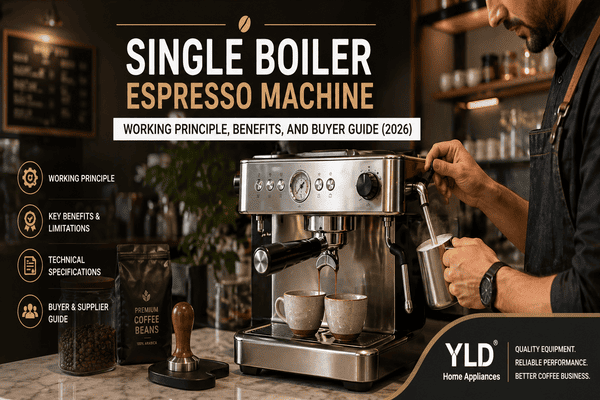

A single boiler espresso machine is one of the most widely used espresso systems for home users, small cafés, office coffee stations, food trucks, and startup coffee businesses. Unlike heat exchange or dual boiler machines, this system uses only one internal boiler to handle both espresso extraction and milk steaming.
This design makes the machine more affordable, compact, and easier to maintain. However, it also creates workflow limitations because users cannot brew espresso and steam milk at the same time.
Most buyers choose a single boiler espresso machine because of lower investment cost, simple maintenance requirements, and lower energy consumption. However, choosing the wrong machine can lead to slow workflow, inconsistent temperature recovery, and poor long-term performance.
In this guide, we will explain the working principle, key benefits, technical specifications, and performance limitations of a single boiler espresso machine. We will also cover pricing factors and the key considerations buyers should evaluate before making a purchase decision.
Quick Answer
A single boiler espresso machine uses one boiler system to heat water for both espresso brewing (90°C–96°C) and milk steaming (120°C–130°C). Most machines operate with:
- Boiler capacity: 0.3L–2L
- Pressure: 8–15 bar
- Power rating: 1000W–3000W
- Daily output: 20–150 cups
- Voltage options: 110V / 220V
These machines are best for low-volume coffee operations.
What is a Single Boiler Espresso Machine?
A single boiler machine contains one internal heating system responsible for two separate tasks:
- Brewing espresso shots
- Producing steam for milk frothing
Instead of using multiple heating systems, the machine switches temperatures depending on selected function.
This simpler design reduces manufacturing cost and machine complexity.
These machines are commonly used in:
- Small coffee shops
- Restaurants
- Offices
- Hotels
- Home kitchens
- Mobile coffee carts
Businesses with low daily coffee demand often choose these machines because they provide good espresso quality without large commercial investment.
Core Components of a Single Boiler Espresso Machine
| Component | Typical Specification | Function | Business Impact |
| Boiler | 0.3L–2L | Water heating | Temperature stability |
| Pump | 8–15 bar | Pressure generation | Espresso extraction |
| Group Head | Brass/Stainless Steel | Water distribution | Shot consistency |
| Steam Wand | Single wand | Milk frothing | Beverage variety |
| Heating Element | 1000W–3000W | Heat generation | Recovery speed |
| Water Tank | 1L–3L | Water storage | Operational flexibility |
These components directly affect performance, durability, and maintenance costs.
How Does a Single Boiler Espresso Machine Work?
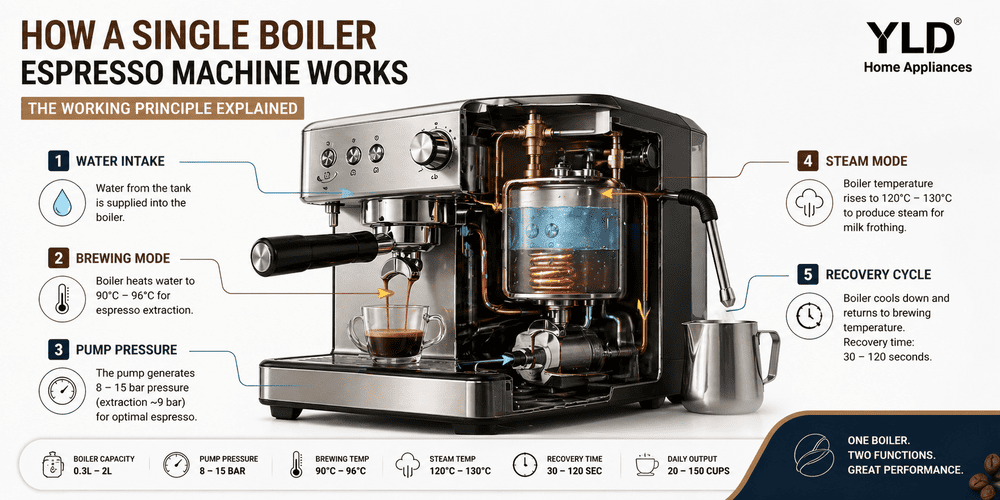
A single boiler espresso machine operates through a sequential heating process where one boiler performs both espresso extraction and milk steaming functions. Since the machine uses a single heating chamber, it cannot brew and steam simultaneously like heat exchange or dual boiler systems.
| Process Stage | Technical Range | Function | Performance Impact |
| Water Supply | 1L–3L reservoir/direct line | Water intake | Operational flexibility |
| Brewing Temperature | 90°C–96°C | Espresso extraction | Shot consistency |
| Pump Pressure | 8–15 bar | Water pressure generation | Extraction quality |
| Steam Temperature | 120°C–130°C | Milk frothing | Steam performance |
| Recovery Time | 30–120 seconds | Temperature reset | Workflow speed |
Step 1: Water Intake
Proper water quality plays a major role in espresso consistency, and the Specialty Coffee Association water guidelines help businesses reduce scale buildup inside boiler systems.
The machine pulls water from either an internal reservoir or a direct plumbing connection. Most home and entry-level commercial machines use 1L–3L removable water tanks, while higher-capacity models may connect directly to water lines for continuous operation.
Water filtration is often recommended because hard water can create mineral buildup inside the boiler.
Step 2: Brewing Temperature Activation
Once activated, the heating element raises boiler temperature to approximately 90°C–96°C, which is the standard range required for espresso extraction.
Temperatures below this range often cause:
- Under extraction
- Weak espresso flavor
- Poor crema formation
Temperatures above this range may result in:
- Over extraction
- Burnt flavor
- Bitter taste
Step 3: Pressure-Based Espresso Extraction
According to espresso brewing standards, proper espresso extraction typically occurs at approximately 9 bars of pressure for balanced flavor and crema consistency.
After reaching brewing temperature, the pump forces hot water through compact coffee grounds.
Most machines advertise 15-bar pumps, but actual extraction usually occurs at approximately 9 bars, which remains the global industry standard for espresso preparation.
The ideal espresso extraction pressure typically remains around P≈9 bar for balanced flavor and proper crema formation.
This pressure level helps maintain balanced extraction and stable crema formation.
Step 4: Steam Generation
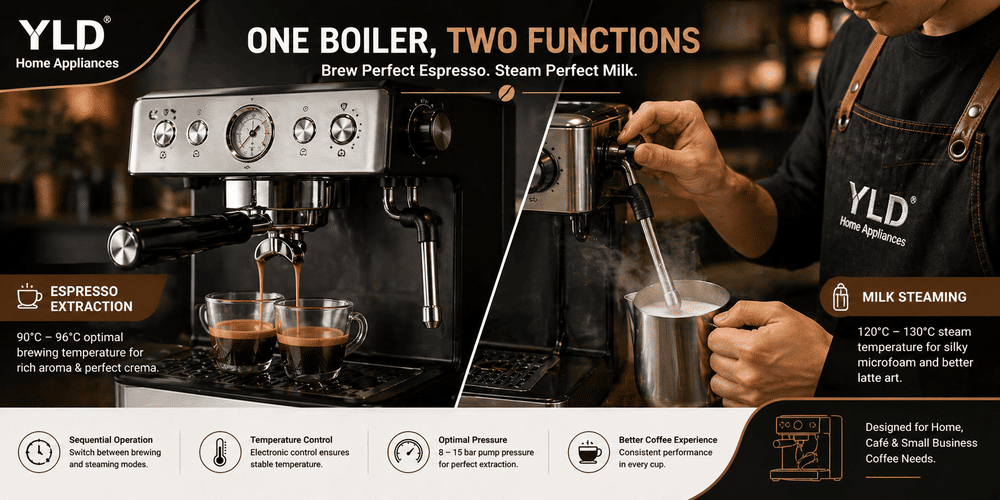
After espresso extraction finishes, the same boiler increases temperature to approximately 120°C–130°C to generate steam.
Most machines produce 1.0–1.5 bar steam pressure, which supports milk frothing for beverages such as:
- Cappuccino
- Latte
- Flat white
- Mocha
Steam performance largely depends on boiler size and heating wattage.
Step 5: Cooling and Recovery Cycle
Before preparing another espresso shot, the boiler must cool down and return to brewing temperature.
Most machines require 30–120 seconds recovery time, depending on:
- Boiler material
- Heating element power
- Internal temperature control system
This recovery delay is one of the biggest operational limitations of a single boiler espresso machine, making it better suited for lower-volume coffee operations.
Single Boiler vs Heat Exchange vs Dual Boiler
This comparison helps buyers avoid selecting oversized machines.
| Feature | Single Boiler | Heat Exchange | Dual Boiler |
| Boilers | 1 | 1 | 2 |
| Brew + Steam Simultaneously | No | Yes | Yes |
| Price | Low | Medium | High |
| Maintenance | Easy | Medium | Complex |
| Daily Output | 20–150 cups | 100–300 cups | 200–500 cups |
| Best For | Small businesses | Medium cafés | Large cafés |
Boiler Materials Used in Single Boiler Espresso Machines
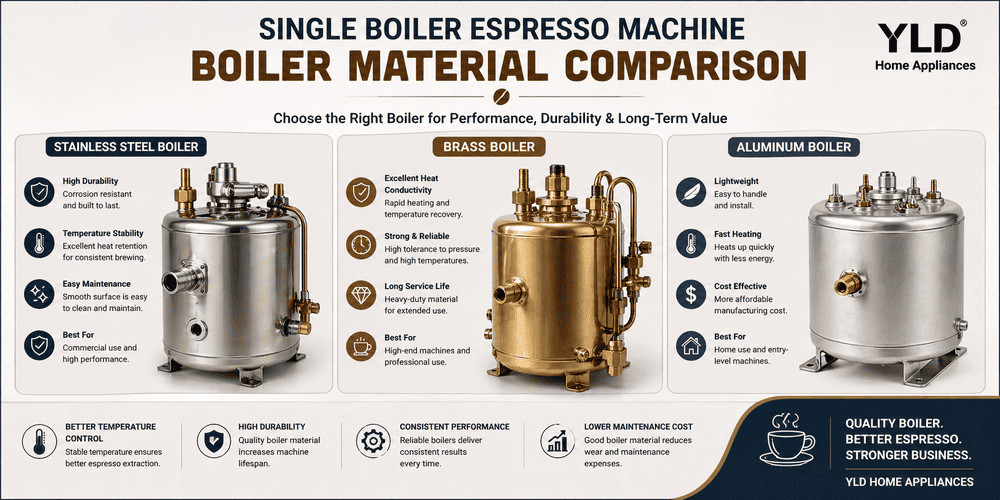
Boiler material directly affects the heating efficiency, temperature stability, corrosion resistance, and long-term durability of a single boiler espresso machine. Since these machines rely on one boiler for both brewing and steaming, material quality plays an important role in overall performance and maintenance costs.
| Boiler Material | Technical Advantage | Performance Impact | Typical Lifespan |
| Stainless Steel | Corrosion resistant | Better hygiene and durability | 5–8 years |
| Brass | High heat retention | Stable brewing temperature | 4–7 years |
| Aluminum | Faster heating speed | Lower manufacturing cost | 2–5 years |
Stainless steel boilers are commonly preferred in commercial and premium machines because they offer strong corrosion resistance, better hygiene standards, and longer operational lifespan.
Brass boilers provide excellent heat retention and temperature stability, making them suitable for users who prioritize consistent espresso extraction.
Aluminum boilers are typically used in lower-cost machines because they heat quickly and reduce manufacturing expenses. However, they generally have shorter lifespans compared to stainless steel and brass systems.
Temperature Stability and Recovery Time in Single Boiler Espresso Machines
Temperature stability directly affects the extraction consistency of a single boiler espresso machine because one boiler handles both brewing and steaming operations. Poor temperature control can lead to inconsistent espresso flavor, weak crema formation, and slower workflow performance.
Machines equipped with PID temperature control systems can maintain brewing temperatures within approximately ±1°C, which helps improve shot consistency and overall espresso quality. In comparison, machines using basic thermostat systems may experience temperature fluctuations of around ±3°C to ±5°C, which can result in inconsistent extraction results.
| Temperature Control System | Temperature Stability | Performance Impact |
| PID System | ±1°C | More consistent extraction |
| Standard Thermostat | ±3°C to ±5°C | Higher temperature fluctuation |
Recovery time is another important factor in a single boiler espresso machine because the boiler must switch between brewing temperature (90°C–96°C) and steam temperature (120°C–130°C).
Recovery speed typically depends on:
- Boiler capacity
- Heating element wattage
- Boiler material
- Internal temperature control system
Most machines require approximately 30–120 seconds to switch between brewing and steaming functions. Machines with larger boilers and higher wattage heating systems usually recover faster and improve workflow efficiency during daily operations.
Benefits of Single Boiler Espresso Machines
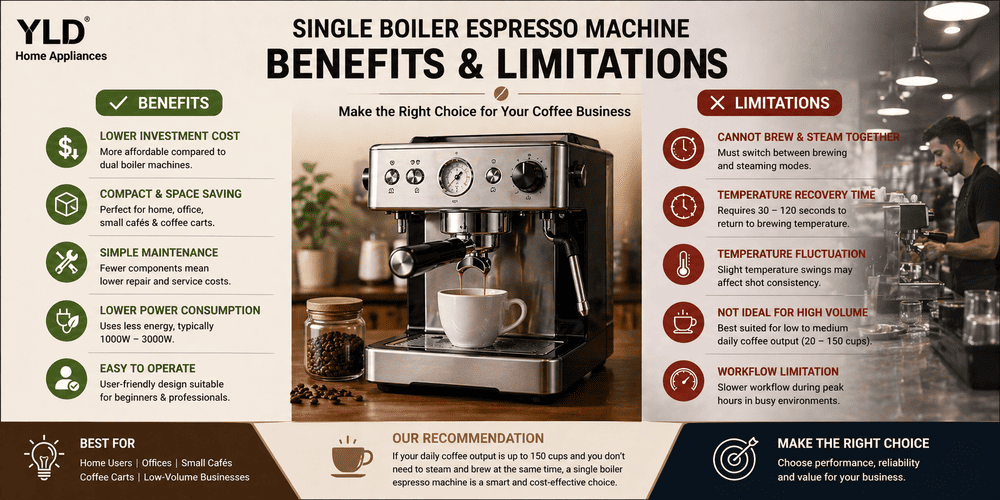
Lower Equipment Investment
A single boiler espresso machine uses one heating system instead of multiple boilers, which reduces manufacturing costs.
Typical market pricing includes:
- Entry-level home models: $300–$800
- Premium home machines: $800–$1,500
- Small commercial models: $1,500–$3,000
In comparison, dual boiler machines often start from $2,500+.
This lower investment makes single boiler systems suitable for startups and small coffee businesses.
Lower Power Consumption
Most single boiler machines operate between 1000W–3000W, depending on boiler size and heating element capacity.
Dual boiler machines often require 4000W–6000W, which increases operational electricity costs.
Lower power requirements make these machines more efficient for smaller businesses.
Faster Heating in Compact Systems
Most single boiler machines use 0.3L–2L boilers, allowing faster heat-up times compared to larger commercial systems.
Most single boiler espresso machines typically require 2–8 minutes to reach the ideal brewing temperature, depending on boiler size and heating element wattage.
This improves convenience for low-volume operations.
Lower Maintenance Costs
Single boiler systems contain fewer internal components such as pumps, heating elements, pipes, and valves.
This typically reduces:
- Repair frequency
- Spare part replacement costs
- Technical maintenance complexity
Most machines require basic maintenance every 3–6 months.
Limitations of Single Boiler Espresso Machines
No Simultaneous Brewing and Steaming
A single boiler espresso machine cannot brew espresso and steam milk simultaneously because one boiler handles both functions.
The machine must switch between:
- Brewing temperature: 90°C–96°C
- Steam temperature: 120°C–130°C
This slows drink preparation.
Longer Recovery Time
Most machines require approximately 30–120 seconds to move between brewing and steaming modes.
Recovery speed depends on:
- Boiler capacity
- Heating wattage
- Temperature control system
Slower recovery reduces workflow efficiency during busy hours.
Lower Daily Output Capacity
Most single boiler espresso machines can typically produce 20–150 cups per day, depending on boiler capacity, workflow efficiency, and beverage demand.
This output is lower than:
- Heat exchange machines: 100–300 cups
- Dual boiler machines: 200–500 cups
Limited Commercial Scalability
These machines perform well in homes, offices, food trucks, and small cafés, but they are not ideal for high-volume restaurants or large coffee chains with continuous customer demand.
Single Boiler Espresso Machine Output Capacity by Business Type
The daily output capacity of a single boiler espresso machine varies based on boiler size, recovery speed, and beverage preparation workflow. Buyers should match machine capacity with expected daily demand to avoid operational delays.
| Business Type | Recommended Daily Output | Suitability |
| Home Users | 5–20 cups | Ideal |
| Small Cafés | 30–80 cups | Suitable |
| Office Coffee Stations | 20–60 cups | Suitable |
| Small Restaurants | 50–120 cups | Moderate |
Businesses with daily demand exceeding 150 cups per day often require heat exchange or dual boiler systems for better workflow efficiency and faster drink production.
How to Choose the Right Single Boiler Espresso Machine Supplier
When sourcing a single boiler espresso machine, buyers should evaluate manufacturing quality, component performance, compliance standards, and long-term operational support instead of focusing only on pricing.
Analyze Boiler Thermal Performance
Since an espresso machine uses one boiler for both brewing and steaming, thermal efficiency directly impacts workflow performance.
Buyers should verify:
- Boiler heating speed
- Temperature recovery time (30–120 seconds)
- Brewing temperature stability (90°C–96°C)
- Steam temperature performance (120°C–130°C)
Poor thermal efficiency slows beverage production.
Evaluate Internal Component Lifespan
The durability of internal components directly affects long-term operational costs. Buyers should inspect the quality of boilers, pumps, valves, heating elements, pipes, and group heads used inside the machine.
Machines built with stainless steel boilers, brass group heads, and higher-quality pumps typically offer better durability and require fewer repairs over time.
Verify Pressure Stability During Extraction
Stable pressure is critical for proper espresso extraction.
Most machines operate with:
- Pump pressure: 8–15 bar
- Actual extraction pressure: ~9 bar
Suppliers should provide pressure testing reports.
Review Daily Production Capacity
Production capacity should match the business model before making a purchase decision. Most single boiler espresso machines can typically produce between 20–150 cups per day, depending on boiler capacity, recovery speed, and beverage preparation workflow.
These machines are usually suitable for homes, offices, food trucks, and small cafés but may struggle in high-volume coffee businesses.
Confirm Electrical Configuration Compatibility
International buyers should verify electrical specifications before importing machines. Common configurations include 110V, 220V, 50Hz, and 60Hz systems depending on target markets.
Incorrect electrical compatibility may create installation challenges and additional operational costs.
Assess Product Customization Capability
Private label buyers often require product customization.
Suppliers should offer:
- Logo branding
- Packaging customization
- Color modifications
- Feature upgrades
This helps distributors build stronger product lines.
Examine After-Sales Service Support
Long-term performance depends on technical support.
Buyers should verify:
- Spare parts availability
- Warranty coverage
- Maintenance support
- Response time for technical issues
Reliable after-sales service helps reduce downtime and protects long-term business operations.
Get Reliable Single Boiler Espresso Machine Solutions
If you are looking for high-quality espresso machine solutions for wholesale, distribution, or private label business growth, YLD Home Appliances offers OEM and ODM manufacturing support tailored to global buyers.
Contact our team today to explore customized coffee machine solutions, competitive pricing, and reliable production support for your business.
Explore More Coffee Equipment Buying Guides
You may also explore our additional coffee equipment guides to compare machine types, technical specifications, and sourcing options for your business needs.
Complete Guide to 2 Group Espresso Machine: Technical Specifications, Uses, Pricing, and Buying Tips (2026)
Complete Guide to Espresso Machine Parts (2026): Names, Functions & Buying Guide
Fully Automatic Espresso Coffee Machine: Is It Worth It for Your Business in 2026?
7 Types of Commercial Coffee Brewer Machines: Complete B2B Buying Guide (2026)
How to Clean Commercial Coffee Brewer Machine (Complete Maintenance Guide 2026)
Final Thoughts
A single boiler espresso machine remains a practical solution for home users, startup cafés, offices, and small beverage businesses that need reliable espresso performance without investing in expensive multi-boiler systems. With brewing temperatures of 90°C–96°C, steam temperatures of 120°C–130°C, and daily output capacities that typically range from 20–150 cups, these machines offer a strong balance between affordability, performance, and operational simplicity.
By understanding working principles, technical specifications, performance limitations, and supplier requirements, buyers can choose a machine that aligns with their daily beverage demand and long-term business goals.