


Commercial kitchens operate under strict throughput requirements. During peak service, preparation delays directly reduce table turnover, increase labor cost per dish, and compromise food consistency across orders.
A high-speed blender for commercial kitchens addresses this at the equipment level — reducing preparation time, standardizing output, and eliminating manual bottlenecks in blending-heavy workflows.
This guide provides a detailed overview of commercial blender motor specifications, blade engineering technologies, duty cycle performance ratings, and key selection criteria for professional food service environments. It is designed to help restaurant owners, café operators, hotel buyers, and wholesale importers evaluate blender performance, durability, operational efficiency, and long term reliability before making commercial purchasing decisions.
Quick Answer
A high-speed commercial blender is a motorized food processing unit rated for continuous-duty operation in professional kitchens. It operates using an induction or universal motor driving stainless steel blade assemblies at 20,000–30,000 RPM, with power ratings ranging from 1500W to 3000W depending on application.
Designed for restaurants, cafés, hotel kitchens, and catering operations, these units process high-viscosity and hard ingredients — including ice, nuts, and frozen produce — at throughput volumes unsuitable for consumer-grade equipment.
What Is a High-Speed Blender for Commercial Kitchens?
To understand this clearly, think of it as a combination of two systems working together.
A blender is a kitchen appliance used to mix, puree, or emulsify ingredients. It is commonly used in kitchens for preparing sauces, smoothies, soups, and other food items.
A high-speed blender for commercial kitchens is designed with a powerful motor that operates at very high RPM. This allows it to process tough ingredients like ice, nuts, and frozen foods quickly and smoothly.
A high-speed blender for commercial kitchens combines both. It functions like a standard blender, but it is built with high power, durable materials, and the ability to run continuously in demanding environments.
This system uses high-wattage motors, stainless steel blades, and large-capacity containers to handle heavy workloads without slowing down.
So instead of using multiple tools or spending extra time on preparation, you get one solution that delivers both speed and consistent performance.
These units are available for wholesale supply and private label manufacturing. For information on bulk supply and custom branding options, visit YLD Group Wholesale Blenders
Why Inefficiency Is a Real Problem in Commercial Kitchens
Inefficiency in kitchens often builds gradually.
During busy hours, staff must handle multiple orders at once. Manual chopping, mixing, or blending slows down the process. Even small delays can affect service speed.
Inconsistent blending also creates quality issues. One batch may be smooth, while another may not meet the same standard.
This problem becomes more noticeable in:
- restaurants with high customer flow
- cafés and juice bars
- hotel kitchens
- catering operations
Studies in food service operations show that inefficient preparation processes can reduce overall productivity by 20–30%.
Without the right equipment, kitchens either slow down or compromise quality.
A high-speed blender for commercial kitchens solves this by improving workflow and reducing preparation time.
For industry-recognized standards on commercial food equipment performance and safety, see Food Equipment Certification — NSF International
How High-Speed Blender For Commercial Kitchens Work?
Blending works through speed and motion. When ingredients move at high speed, they mix evenly and create a smooth result.
A high-speed blender for commercial kitchens uses a powerful motor to spin blades at very high speed. This creates a vortex that pulls ingredients downward. The blades crush hard ingredients, break down fibers, and create smooth textures. Typical performance:
Motor Type
Commercial high-speed blenders use either induction motors or brush-type universal motors. Induction motors offer longer operational lifespan, lower heat generation, and quieter operation — making them preferred in high-duty-cycle environments. Universal motors produce higher peak RPM but generate more friction heat under continuous load.
Blade Mechanics
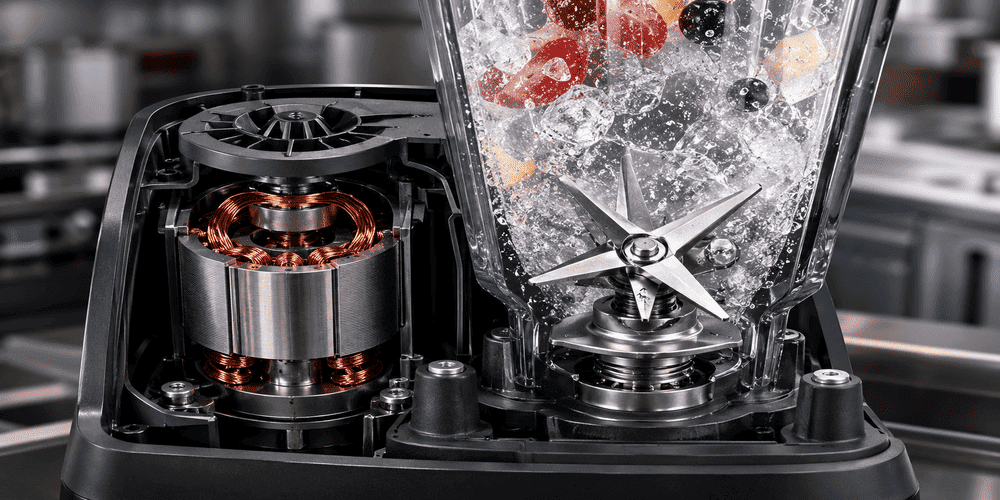
Blade assemblies rotate at 20,000–30,000 RPM, generating centrifugal force that creates a low-pressure vortex at the blade center. This draws ingredients inward and downward into the cutting path continuously. Multi-angle blade configurations — typically 4 to 6 tips at staggered angles — ensure cross-directional cutting and prevent ingredient stratification inside the jar.
Thermal Behavior
At sustained RPM, blade friction raises internal jar temperature. In professional countertop models rated for soup preparation, this heat elevation is calibrated to bring liquid contents to serving temperature without external heating. Units not rated for hot processing should not be used for this application, as thermal expansion affects jar integrity and seal performance.
Duty Cycle
Duty cycle defines the ratio of operational time to rest time the motor can sustain without thermal overload.
A 50% duty cycle (30 seconds on, 30 seconds off) is standard for mid-range commercial units. Continuous-duty motors (100% rated) are required for high-volume kitchens running blending cycles with less than 60 seconds between operations.
At high speeds, friction can also generate heat. This allows some blenders to prepare hot soups directly. Because of this system, the blender delivers consistent blending performance across every batch.
For a technical explanation of IEC motor duty cycle classifications and their operational implications, see IEC Electric Motor Duty Cycles — Engineering Toolbox
Benefits of High-Speed Blender for Commercial Kitchens
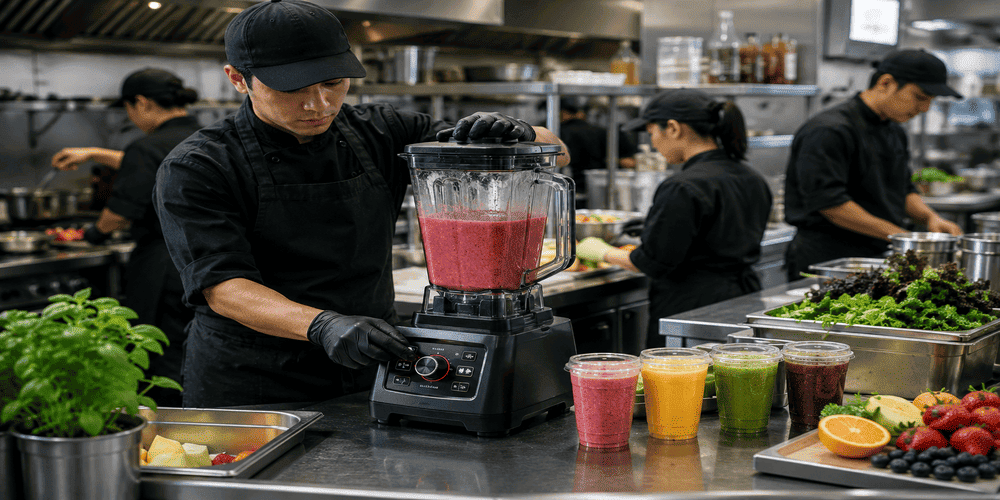
A high-speed blender for commercial kitchens is designed to solve two common kitchen problems at the same time: slow preparation and inconsistent results.
Instead of relying on manual work or multiple tools, it creates a faster and more efficient workflow.
In real-world commercial kitchens, this leads to quicker service, better food quality, and more organized operations.
Key benefits include:
- Improves kitchen efficiency
High-speed blending reduces preparation time and helps staff complete tasks faster, especially during busy hours.
- Handles high-volume food preparation
It allows kitchens to process large batches without slowing down, making it ideal for restaurants and catering operations.
- Ensures consistent blending performance
Each batch is processed evenly, which helps maintain the same texture and quality across all servings.
- Supports multi-purpose use
It can be used for smoothies, sauces, soups, and purees, reducing the need for multiple pieces of equipment.
- Reduces manual work
Less manual effort is required, which improves productivity and reduces workload on kitchen staff.
- Supports commercial kitchen operations
It integrates easily into professional setups and works as a key part of modern commercial kitchen equipment.
Where to Use High-Speed Blender For Commercial Kitchens
High-speed blender for commercial kitchens perform best when used in environments that require speed and consistency.
Restaurants
Restaurants require fast preparation during peak hours.
High-speed blenders help by:
- speeding up sauce and soup preparation
- maintaining consistent food quality
- reducing workload during busy periods
Cafés and Juice Bars
These environments rely heavily on blending.
High-speed blenders:
- prepare smoothies quickly
- handle ice and frozen fruits easily
- ensure consistent drink quality
Hotel Kitchens
Hotels handle large-scale operations.
Blenders help by:
- supporting bulk food preparation
- maintaining consistent results across services
- improving efficiency in multiple kitchen sections
Catering Services
Catering requires large batch preparation.
High-speed blenders:
- process ingredients quickly
- maintain uniform texture
- reduce preparation time
Cloud Kitchens
Delivery-focused kitchens require speed.
Blenders help by:
- reducing delays in preparation
- improving order handling speed
- maintaining quality consistency
Types of High-Speed Blender For Commercial Kitchens
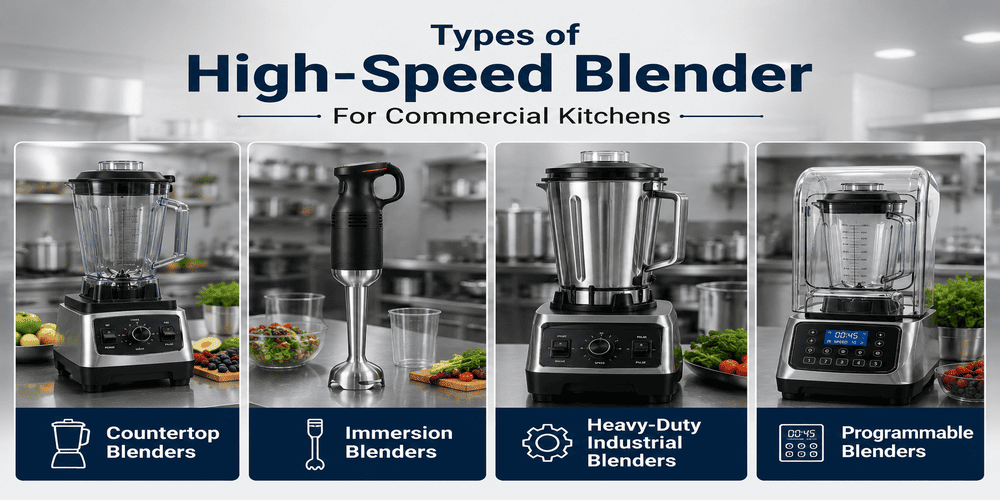
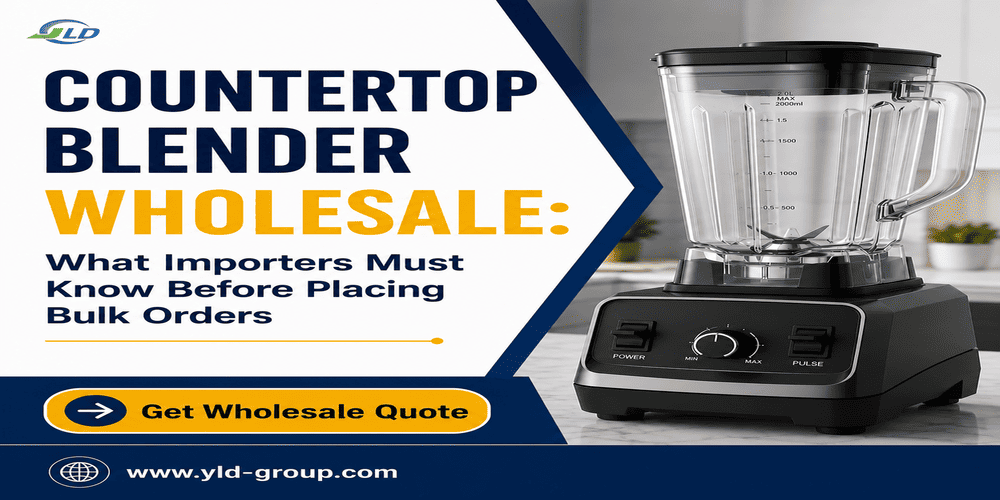
Countertop Blenders
Countertop blenders are commonly used in restaurants and cafés.
They are designed for daily blending tasks and sit easily on kitchen counters. They usually have medium capacity and balanced performance.
Most models have 1500W–2000W motor power, which is suitable for smoothies, sauces, and light commercial use.
They are compact and easy to use. However, they are not suitable for heavy or continuous industrial work.
Immersion Blenders
Immersion blenders are handheld tools used for direct blending.
They are used inside pots and containers without transferring ingredients. This makes them useful for soups and sauces.
Power usually ranges from 600W–1000W depending on the model.
They are flexible and quick to use. But they are not designed for large batches.
For handheld and immersion blender specifications, see Hand Blenders — YLD Group Product Category
Heavy-Duty Industrial Blenders
Heavy-duty blenders are made for large commercial kitchens.
They are built with powerful motors, usually 2000W–3000W or more. They support continuous operation.
These machines handle large quantities of ingredients easily. They are used in restaurants, hotels, and catering setups.
They are strong and durable. However, they require more space and higher investment.
Programmable Blenders
Programmable blenders are designed for control and consistency.
They come with preset functions that control speed and time automatically. This reduces manual work.
They are used in professional kitchens where consistent results are important.
They help standardize recipes and improve workflow.
What Actually Affects Blender Performance
| Type | Motor Power | RPM Range | Capacity | Duty Cycle | Best Use |
| Countertop Blender | 1500W–2000W | 20,000–25,000 | 1.5–2L | 50–75% | Restaurants, cafés |
| Immersion Blender | 600W–1000W | 8,000–15,000 | Variable | 30–50% | Soups, sauces |
| Heavy-Duty Blender | 2000W–3000W | 25,000–30,000 | 2–3L+ | 75–100% | Hotels, catering |
| Programmable Blender | 1500W–2500W | 20,000–28,000 | 1.5–3L | 50–75% | Commercial kitchens |
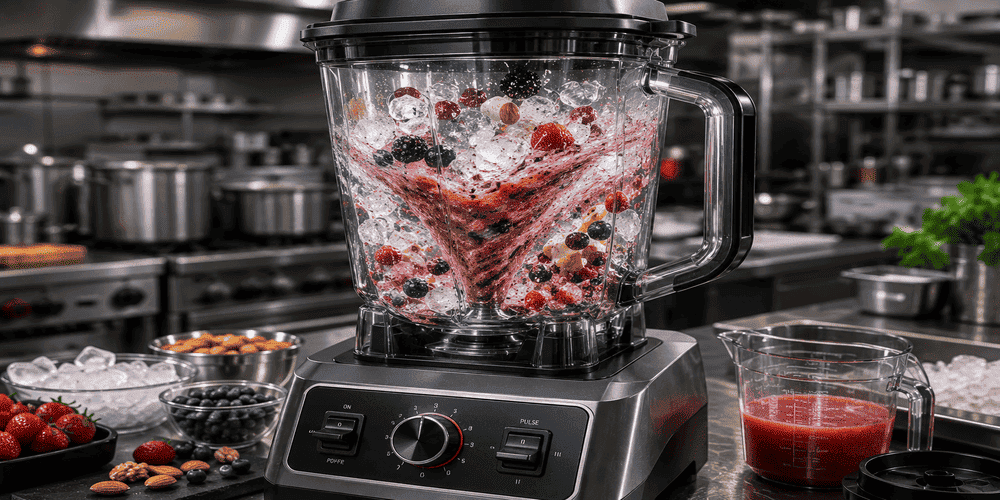
Blender performance is not just about choosing a powerful machine. In real-world use, how well a high-speed blender for commercial kitchens performs depends on a combination of motor strength, blade quality, capacity, and proper usage.
Many people assume that a high-wattage blender is enough, but performance only improves when all factors work together correctly.
Key Factors That Affect Performance
| Factor | Typical Range | What It Means in Practice |
| Motor Power | 1500W – 3000W | Higher power ensures faster blending and better handling of tough ingredients |
| Speed (RPM) | 20,000 – 30,000 | Higher RPM creates smoother texture and faster processing |
| Blade Quality | Stainless Steel | Strong blades improve durability and long-term consistency |
| Capacity | 1.5 – 3 Liters | Larger capacity supports high-volume food preparation |
| Usage Time | Continuous Duty | Allows long operation in commercial kitchens without overheating |
Even a powerful blender will underperform if it is not used correctly or if the setup is not suitable for commercial workload.
For example, overloading the blender or using it beyond its capacity can reduce efficiency and damage performance over time. Similarly, dull blades or incorrect speed settings can affect blending quality.
In real commercial kitchens, the most common mistake is choosing a blender based only on power instead of overall performance factors like capacity, durability, and usage requirements.
A well-chosen system with proper usage will always deliver better results than a high-end machine used incorrectly.
In simple terms, blender performance is not just about the machine—it is about how the entire system is selected, used, and maintained in real kitchen environments.
High-Speed Blender vs Traditional Blender
At first glance, both traditional blenders and high-speed blenders may look similar. Both are used for mixing and processing ingredients in the kitchen.
But in real-world use, their performance and capabilities are completely different.
A traditional blender is designed for basic kitchen tasks. It works well for light blending but struggles with tough ingredients and heavy workloads.
A high-speed blender for commercial kitchens, on the other hand, is designed for power and continuous operation. It handles large quantities, hard ingredients, and delivers consistent results even during peak usage.
Key Differences
| Feature | Traditional Blender | High-Speed Blender |
| Function | Basic blending for home use | Advanced blending for commercial use |
| Speed | Low to medium RPM | Very high RPM (20,000–30,000) |
| Efficiency | Slower processing | Faster workflow and improved kitchen efficiency |
| Capacity | Small batches only | High-volume food preparation |
In a home kitchen, a traditional blender is usually enough because the workload is low.
However, in restaurants, cafés, and commercial kitchens, demand is much higher. This is where high-speed blender for commercial kitchens make a clear difference in performance.
Instead of just basic mixing, they improve workflow, reduce preparation time, and ensure consistent results in every batch.
In simple terms, a traditional blender handles simple tasks, while a high-speed blender for commercial kitchens is built to handle professional commercial kitchen demands efficiently.
Why Choose a High-Speed Blender for Commercial Kitchens
When it comes to commercial kitchens, the motor quality and build strength play a major role in performance and durability. This is why most professional kitchens use high-speed blenders instead of standard blending machines.
A high-speed blender for commercial kitchens is designed for continuous operation and heavy workloads. It delivers consistent performance, especially in high-volume food preparation, which is essential for restaurants, cafés, and catering businesses.
Why It Works So Well
- Reliable performance under heavy use
It maintains stable performance even during long operating hours, ensuring smooth workflow in busy kitchens.
- Handles large volumes efficiently
It is designed to process bigger batches at once, which supports fast production in commercial environments.
- Reduces preparation time
High-speed motors significantly cut down blending time, helping kitchens serve faster during peak hours.
- Supports consistent output
Every batch is processed evenly, ensuring the same texture and quality across all servings.
- Built for long-term use
Strong materials and commercial-grade components ensure durability even under daily heavy usage.
In real kitchen environments, this means fewer delays and a smoother workflow during busy hours.
It helps staff complete tasks faster without compromising quality or consistency.
In simple terms, a high-speed blender for commercial kitchens improves overall kitchen efficiency and supports professional food operations.
For information on custom product development, visit YLD Group OEM/ODM Solutions
Cost vs Performance: What You Actually Get for the Price
The cost of a high-speed blender for commercial kitchens depends on motor power, build quality, capacity, and durability.
But in real kitchen use, price is not just about the machine — it directly affects performance, efficiency, and long-term reliability.
Typical Price Range in Real Projects
| Type | Price Range | Unit | Typical Use Case |
| Basic commercial blender | $80 – $200 | per unit | Small cafés |
| Standard high-speed blender | $200 – $500 | per unit | Restaurants |
| Heavy-duty blender | $500 – $1200 | per unit | Hotels |
| Industrial blender | $1200 – $3000+ | per unit | Large-scale kitchens |
What Affects the Price in Practice
- Motor power
Higher wattage motors (1500W–3000W) increase performance and cost.
- Build quality
Stronger materials and commercial-grade construction improve durability.
- Blade durability
High-quality stainless steel blades last longer and perform better.
- Capacity
Larger jars increase cost but support high-volume food preparation.
- Brand and features
Advanced controls, speed settings, and programming increase price.
What This Means in Real Use
Lower-cost blenders may look similar, but they often use weaker motors and lower-grade materials.
As a result, they may:
- overheat during heavy use
- deliver inconsistent blending results
- require frequent replacement
As a result, the overall productivity and efficiency of the kitchen are directly affected by the quality of the blender.
On the other hand, higher-quality commercial blenders:
- maintain stable performance under pressure
- improve kitchen efficiency
- last longer even with daily heavy use
In simple terms, you are not just paying for a blender — you are paying for consistent performance and reliable operation in a commercial kitchen environment.
How to Choose the Right High-Speed Blender for Commercial Kitchens?
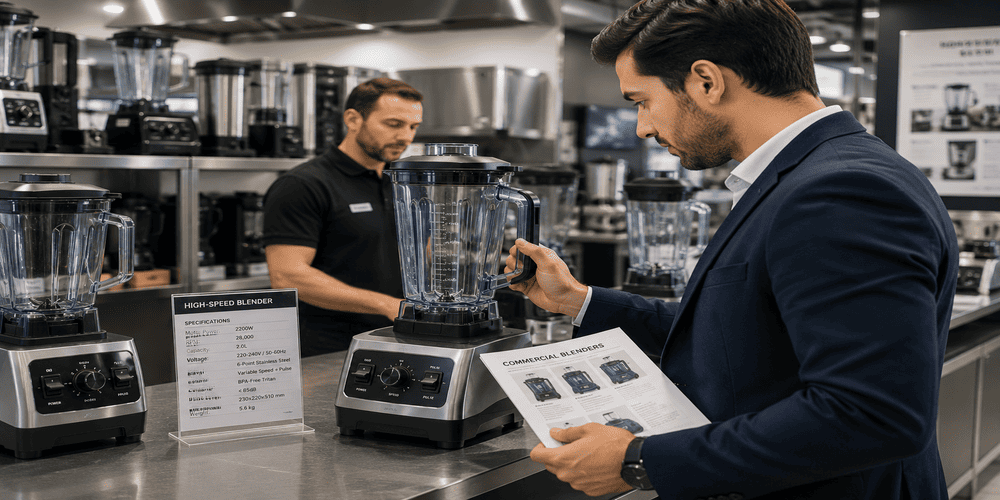
Choosing the right high-speed blender for commercial kitchens is not just about power — it’s about matching the machine with how the kitchen actually operates.
Here’s a simple step-by-step guide to help you make the right decision:
Step 1: Define Operational Load
Calculate daily blending cycles per unit. If a single blender will run more than 40 cycles per service period, specify a continuous-duty motor. If cycles are under 20 per period with adequate rest time, a 50–75% duty cycle unit is sufficient.
Step 2: Match Motor Construction to Environment
For kitchens with high ambient temperature (above 35°C) or poor ventilation, induction motors with IP-rated enclosures are recommended. Universal motors are acceptable in climate-controlled environments with lower cycle frequency.
Step 3: Specify Blade Configuration for Ingredient Type
- Soft fruits, leafy vegetables → 4-tip standard blade, 1500W sufficient
- Ice, frozen produce, nuts → 6-tip reinforced blade, minimum 2000W
- Fibrous vegetables, whole spices → 6-tip cross-cut blade, minimum 2500W
Step 4: Confirm Certification for Your Market
- EU market → CE marking + RoHS compliance mandatory
- US market → UL or ETL certification required for commercial installation
- Multi-region → CB certification covers most international markets
Step 5: Evaluate Supplier QC Consistency
Sample approval does not guarantee batch consistency. Request QC report data across minimum 3 production batches before committing to volume orders.
Final Key Takeaways
- Duty cycle over wattage: A 2000W motor with 50% duty cycle fails under peak-hour load. Always verify both specs.
- Motor construction matters: Copper-wound induction motors outlast aluminum-wound motors in continuous commercial use.
- Match blades to ingredients: 6-tip reinforced blades for ice and frozen produce. 4-tip for soft ingredients only.
- Certifications are legal requirements: CE + RoHS for EU. UL or ETL for US. No exceptions.
- Test batches, not samples: One approved sample does not guarantee production consistency.
- Judge by total cost, not unit price: A blender lasting 5+ years costs less per cycle than a cheap unit replaced every 18 months.
Conclusion
A high-speed blender for commercial kitchens is not just a tool. It is a performance solution.
By combining speed, power, and consistency, it helps kitchens operate more efficiently and handle high-volume food preparation without delays.
When chosen correctly, it improves workflow, reduces effort, and ensures consistent quality across all operations.
In modern commercial kitchens, it is no longer optional—it is essential.
FAQS
1. What is a high-speed blender for commercial kitchens?
A high-speed blender is a powerful kitchen machine designed for fast and efficient blending. It is used in commercial kitchens to process large quantities of food like smoothies, sauces, soups, and purees with consistent results.
2. Do high-speed blenders actually improve kitchen efficiency?
Yes, they significantly improve efficiency. They reduce preparation time, handle heavy workloads, and ensure faster service during peak kitchen hours.
3. What material is commonly used in commercial blenders?
Most commercial high-speed blenders use stainless steel blades and durable BPA-free containers. These materials ensure strength, safety, and long-term performance.
4. Where are high-speed blenders typically used?
They are commonly used in restaurants, cafés, hotels, juice bars, catering services, and cloud kitchens where fast and consistent food preparation is required.
5. Are high-speed blenders better than traditional blenders?
Yes, in commercial use they are much better. Traditional blenders are suitable for home use, while high-speed blender for commercial kitchens are designed for heavy-duty and continuous operation.
6. How long do commercial high-speed blenders last?
A good quality commercial blender can last around 5–10 years. Lifespan depends on usage frequency, maintenance, and build quality.
7. Do high-speed blenders affect food quality?
No, they actually improve it. They create smoother textures and consistent results, especially for soups, sauces, and smoothies.
8. Are commercial high-speed blenders expensive?
The cost varies based on motor power, capacity, and features. Basic models are affordable, while industrial-grade blenders are more expensive due to higher performance and durability.
9. Can high-speed blenders be used for all types of food?
Yes, they can handle a wide range of ingredients including fruits, vegetables, ice, nuts, and frozen items, making them highly versatile.
10. Do high-speed blenders require maintenance?
Yes, but very minimal. Regular cleaning, blade checking, and proper usage are usually enough to maintain performance.
11. Are high-speed blenders suitable for small cafés?
Yes, smaller commercial models are perfect for cafés. They help handle daily blending tasks efficiently without slowing down service.
12. Do high-speed blenders consume a lot of electricity?
They use higher power, but they operate for shorter time periods. In real use, they are energy-efficient due to faster processing times.